
Resistance Through Jazz: The Identitarian Riot of The Harlem Kiddies
The story of one of Denmark's most impactful jazz groups of the 1940s and the resistance inherited by their sheer existence.

For months, I have been meaning to write an article on the Harlem Kiddies, sometimes having countless research tabs open for months before accepting that I couldn’t crack it. The story was there, but I struggled to identify the essence of why it is still relevant to tell, and like so many other stories, it ended with a blank page. But, alas, here we finally are.
Up until recently, the world seemed generally aligned that the present is de facto at the forefront of the best humanity has ever been, at least in the context of modern-day liberals.
We are innovative, technologically advanced, ostensibly fighting fewer wars, more aware of human rights, and so on. It created the notion that anything that evolves makes the next day in the existence of humanity better than the previous. And that always struck with a sense of ignorance. The concept of trusting that progression in our contemporary society is purely meant to alleviate us entirely disregards the abundance of people in power, still fueled by an ideology rooted in deeply regressive sentiments.
As we think of the presence in the light of progression, the past ought to be the memory of the opposite. Retrospective thinking becomes absolutist insofar as making societal conclusions goes. In many, many ways, the past was certainly much worse for most people compared to where society generally is today. However, writing off the past as being retrogressive undermines a great deal of effort put into social change. It makes us blind to the many moments in history in which progressive ideas of solidarity far exceeded those of today, and to the people who fought for a more accepting world in places that were not. Some of this can be ascribed to the fact that there was simply more regression to respond to in the past, but that makes it all the more impressive.
Those thoughts on retrospective absolutism of the past bring me to the actual topic, the Harlem Kiddies.
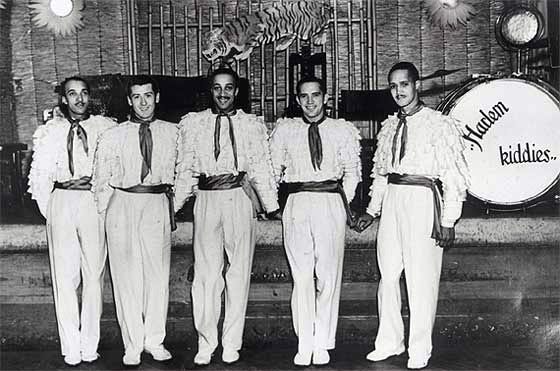
A Danish jazz group, following in the slipstream of what is broadly known as Copenhagen’s Golden Era of Jazz in the 1920s and 1930s. Before World War II broke out, the Copenhagen jazz scene was an international microcosm blossoming from a mix of local artists. It drew inspiration from the New Orleans and New York jazz scenes, as well as visiting epochal artists. Sam Wooding, the first American artist to perform in Copenhagen, followed by Josephine Baker, Louis Armstrong, etc.
The frequent visits from some of the genre’s most defining artists cemented jazz as the sound of the Danish youth during this time. This remained the case until 1940 when the German occupation began. Up until this point, Danish jazz had been sustained by an interrelation of international artists visiting and Danish artists shaping a responding sound, but as a result of occupation, the scene was forced to transform into an isolated, more monolithic, local scene.
Prompted by this sudden isolation from the international jazz scene, groups like Harlem Kiddies formed in December 1940. A group of local Copenhagen artists consisting of African-American-Danish brothers Jimmi and Johnny Campbell, Congolese-Danish Kaj Timmerman, and the Danish-Jewish singer, Raquel Rastenni.
The idea of forming a group of both black and white members came from drummer Kaj Timmermann. Alongside other later members of Harlem Kiddies, he initially established Timmerman Orchestra, later renamed the Black and White Quartet, before eventually settling on Harlem Kiddies.
Members of the group had previously worked as entertainers and bicycle artists prior to forming the group, which stood in stark contrast to the wrongful preconception that jazz belonged to the social elite. That type of imposed ownership over jazz as a societal signifier, especially among white communities, was not a foreign concept by the 1930s. Jazz had quickly gone from a niche blues-rooted genre created by African-American artists to a genre for the broad masses. Through the 1930s, jazz saw more and more white record label execs venturing into the genre, eyeing profit in this newfound mainstream appeal.
The New Orleans jazz scene that led to the emergence of swing became a household genre through the 1920s, after which it gradually branched into subgenres like swing, cool jazz, and bebop. In ways similar to what later happened with rock, soul, and hip-hop, jazz also developed into a parallel sweet jazz genre, a soft, slower way of playing that was generally performed by and appealed to white audiences.
The origins of jazz within African-American communities that were subsequently imitated, exploited, and/or celebrated by white artists hint at a two-sided societal perception of jazz that would surround groups like Harlem Kiddies.
On one hand, jazz being performed by black artists in predominantly white spaces was deemed more authentic than that of white artists. With the pan-black sentiment that very much surrounded this time, the association of black artists at large was easily conflated with African-American artists, therefore, the ‘inventors of jazz’. Thus, the presence of a non-white jazz ensemble in the 1940s carried an ostensibly inherent quality that people wanted to identify their appreciation for jazz with.
On the other hand, the same notion of authenticity through African-Americanism also contributed to an alienation of the artists, insofar as questioning the Danish-ness of a group that defied the, at the time, rigid perception of the Danish identity.
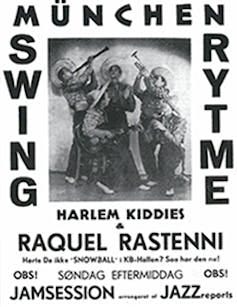
However, by the time the Harlem Kiddies opened at Café München (an ironic name for a jazz venue in Copenhagen during the occupation) in 1941, the notion of Danish identity had come up for negotiation. Prompted by the German occupation, the local jazz scene exploded with a vast surge in local records produced between 1939 and 1940. Despite Germany attempting to impose a general ban on jazz as well as countless other Black and Jewish artists, the censorship on entertainment was not easily deployed in practice. The local population considered jazz the global response to the oppressive regime, but in fear of an uprising, the regime failed to shut it down.
In a sense, what led people to find quality in the music during the time of oppression also led them to renegotiate the collective Danish identity. That is not to say that the group was not exoticized and labelled as ‘authentic jazz’ as a result of their racial background. The social disposition to make racial differentiation prevailed, but they nevertheless became part of a shared identity in opposition to the imposing occupation.
As Anne Dvinge writes in her essay ‘Between The Devil and The Deep Blue Sea’
By insisting in a diasporic and hybrid Danishness, the Harlem Kiddies challenged what ‘Danish’ was (and is) in an open-ended articulation that continues to resist domestication.
As a result of this identitarian hybridity, Harlem Kiddies became an embodiment of resistance. A sort of accumulative societal response to the occupation. That inherent sense of riot amplified the awareness of the group, which was enhanced further by the collective need for escapism during the wartime.
Musically, Harlem Kiddies continued off the swing tendencies of the 1930s, with Johnny Campbell being considered a particularly talented saxophonist. The group’s first recording in 1941, Argentina (A-Side) and Between The Devil And The Deep Blue Sea, was followed by One O Clock Jump and I Ain’t Got Nobody the same year. They continued to perform consistently across the Copenhagen jazz scene during the early 1940s and established themselves as one of the time’s most relevant local jazz groups. Their impact on contemporary pop culture was encapsulated with their appearance playing themselves in the 1942 film ‘Lykken Kommer’.
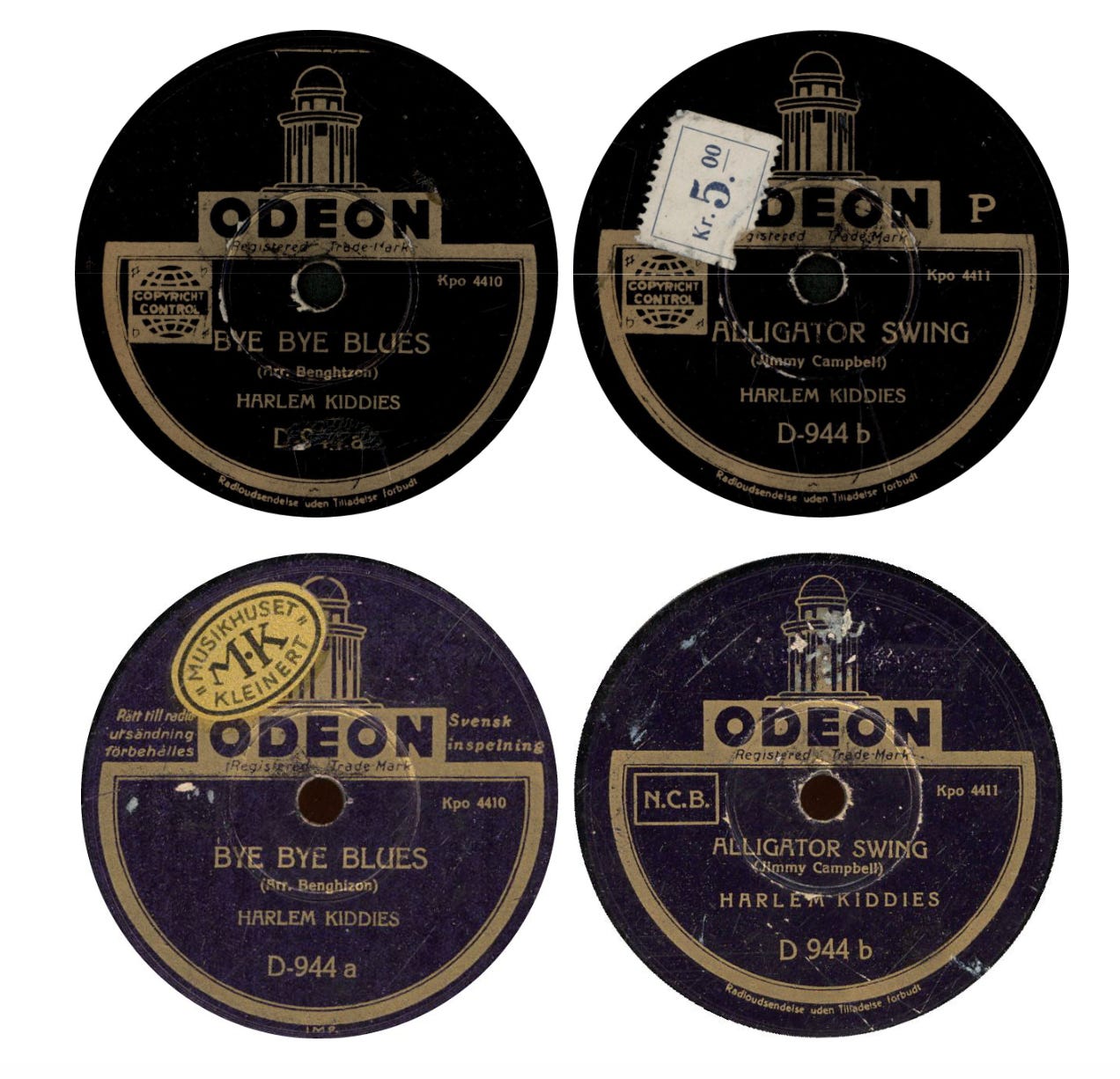
Despite their local influence and ability to manoeuvre around the impending political pressure against their music and sheer presence, the group had to leave Copenhagen in 1943 due to increasing pressure from the German occupation. To avoid prosecution, Raquel Rastenni fled to Sweden, where the group would later meet to record from 1944 onwards.
With the end of the occupation in 1945, the interest in Harlem Kiddies gradually decreased. Although they continued to release new material, the resisting virtues had fallen somewhat out of relevance post-war. The group’s founder, Kaj Timmermann, left the group in 1947, while the remaining members continued to play together well into the 1950s.
Raquel Rastenni built an impressive career as a solo artist. Her 1953 album Hele Ugen Alene became the first Danish record to ever get gold certification. Meanwhile, Johnny and Jimmi Campbell ventured into the emerging bebop scene and continued to perform until the 1990s.
Despite an undeniable impact on Danish Jazz during the war years and an appeal that transcended into other pop cultural media as well, information around the Harlem Kiddies is limited. To this day, the group is generally not considered an integral part of the Danish jazz canon.
Somehow, the story of the group fell into oblivion and has only been told sporadically since. In 1968, the Campbell brothers both appeared in Den Gylden Swingtid (The Golden Swing Time), a Danish live-concert TV show highlighting the greatest local artists from the 1930s and 1940s.
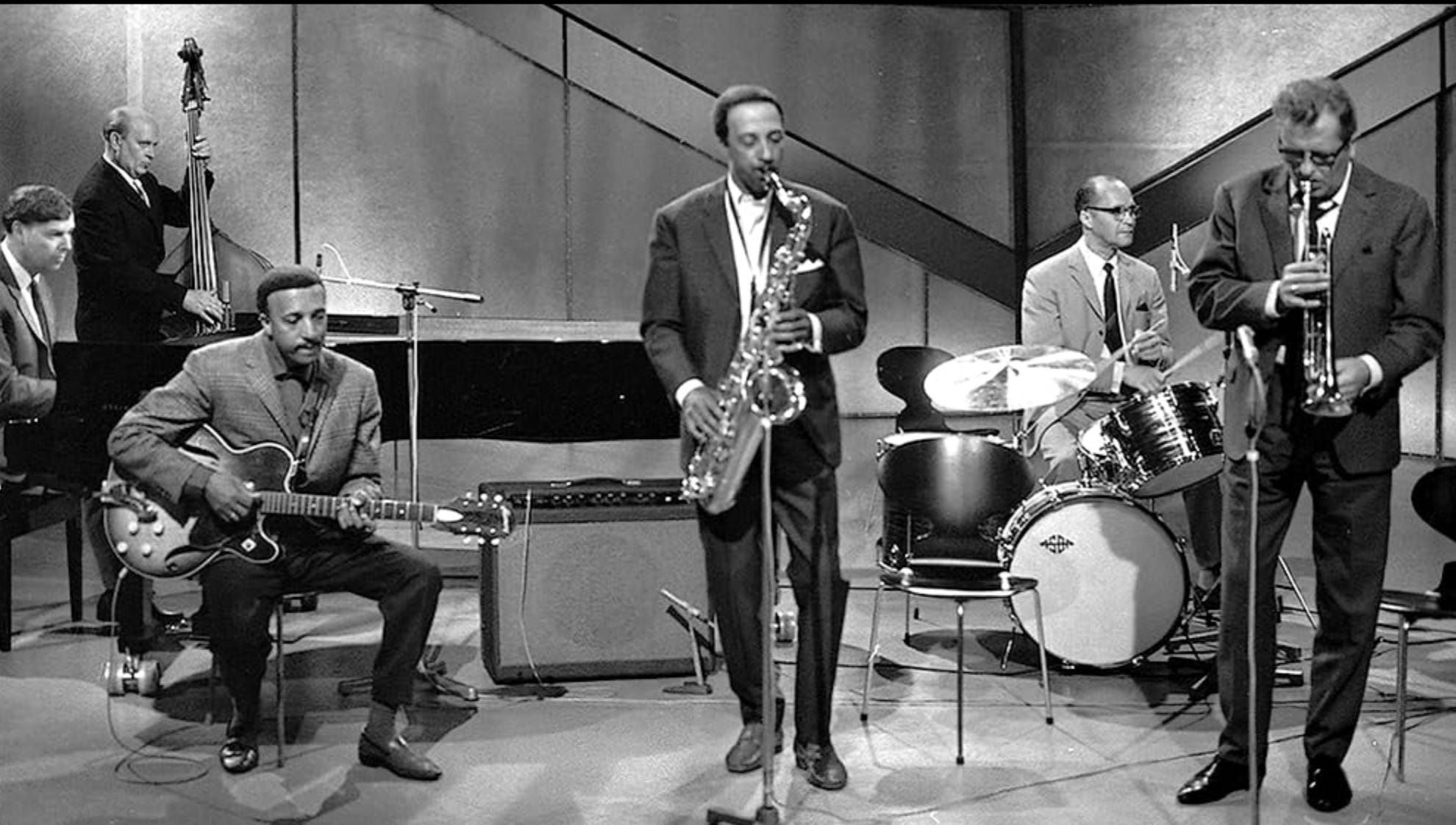
While the group never got the recognition they rightfully deserved, their place in Danish music history is about more than jazz. Their work during the occupation not only contested the oppression of the collective identity but also challenged the concept of Danish identity itself.
Ultimately, the story of Harlem Kiddies is a story of solidarity, a gathering of people, and a complex, yet embracing sense of identity. In the bigger picture, their history is much more accurate in the historical context of ethnical, religious, and artistic differences than what conservative Europe to this day cares to think. In her extensive essay on the topic, Anne Dvinge makes the case that the story of Harlem Kiddies “...corrects the image of ‘Danishness’ as being one particular thing.”
Denmark and Europe at large have always been subject to people and cultural input coming from elsewhere. Identity is an ever-changing event of migratory flows, and the recurring tendency to simplify it is an attempt to paint a picture that never existed as such. To this day, European countries obstinately insist that the essence of their national identity ought to look and act in a certain way. A rigid fight for a one-sided identitarian narrative that leads to more alienation than reconciliation, which leads one to wonder if we learned anything at all.
Thus, rather than being an anecdote of an abnormal time, the story of Harlem Kiddies is a re-evaluation of our historical sense of identity. One that emphasises that our identity, and the way we understand it when under threat, is much more than a static reflection of a rigid pre-conception of what it ought to look and act like.
Thanks for reading.
This article heavily revolved around Anne Dvinge's research topic in her essay Between the Devil and the Deep Blue Sea from 2015. It remains the most extensive body of work on the history of Harlem Kiddies.
Other, more restricted material on the topic can be found below:
https://jazznyt.blogspot.com/2006/11/dansk-topklasse-bebop-fra-50erne.html
https://www.kristeligt-dagblad.dk/danmark/danskheden-har-altid-v%C3%A6ret-til-forhandling-0
Lykken Kommer, Nordisk Film (1942)